
Why This Matters Going Into 2026
Every year, the pressure on HR teams to do more with less grows a little heavier. Skills gaps, hybrid work, and rising expectations around career growth aren't going away in 2026. If anything, they're becoming the baseline HR has to plan around. In the World Economic Forum's Future of Jobs Report 2025, 63% of employers named skills gaps as the biggest barrier to transforming their business.
That's exactly the kind of problem a talent management framework is built to solve. Instead of treating recruitment, onboarding, development, and retention as separate jobs handled by separate tools, a framework connects them into one deliberate system, tied to where the business is headed and not just this quarter's hiring plan.
This guide walks through what a talent management framework includes, the shift toward skills-based talent management happening across HR right now, and a practical way to start building one in 2026, even if your current setup is a handful of disconnected tools.
What Is a Talent Management Framework?
A talent management framework is a structured approach that connects every stage of the employee lifecycle (workforce planning, hiring, onboarding, development, performance, and retention) back to the organization's goals. Rather than treating each of these as an isolated HR task, a framework treats them as one continuous system. The people you hire should reflect the skills the business will need next year. The training you invest in should build toward where roles are heading. And the data from performance reviews should inform how you plan headcount, not just who gets a raise.
Done well, a framework turns a list of HR activities into a coherent people strategy.
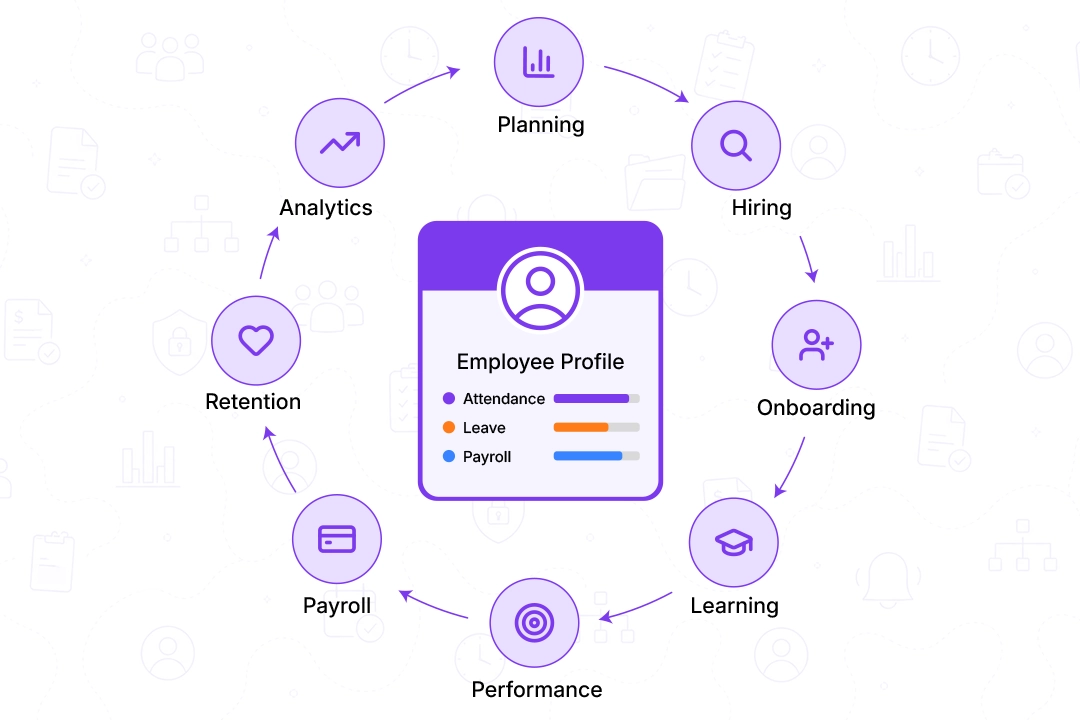
The 9 Core Components of a Talent Management Framework
1. Workforce Planning & Strategy
Before you hire anyone, start by mapping the skills and roles the business will need, not just the vacancy that opened up. Forecasting future needs against the people you already have means gaps show up before they become urgent, instead of during exit interviews.
2. Recruitment & Hiring
Smart hiring means aligning job postings and interview processes with the roles you've planned for, not reacting to whoever's available. A structured recruitment process, backed by clear role requirements, cuts down on mismatched hires later.
3. Onboarding
The first 90 days set the tone for retention. A framework treats onboarding as a structured process: managing employee documents like IDs, contracts, and compliance paperwork, tracking assigned equipment such as laptops and access cards, and getting system access sorted. It shouldn't depend on a checklist someone remembers to send.
4. Learning & Development
Skills gaps don't close themselves. Ongoing training tied to real roles, rather than one-off compliance modules, is what keeps a workforce ready for what's next.
5. Performance Management
Structured, ongoing feedback, not just an annual review, tells you who's ready for more responsibility and where skills are lacking. When goal setting and 360-degree feedback live in one place, those insights feed straight back into workforce planning.
6. Compensation & Payroll
Fair, accurate, and transparent pay is a retention lever, not just an administrative task. That includes payroll management that keeps up with role changes, promotions, and multi-country teams.
7. Employee Engagement & Retention
This covers everything from a leave management system employees can use without friction to career pathing that gives people a real reason to stay.
8. Succession Planning
Knowing who could step into a critical role tomorrow, instead of scrambling the day someone resigns, depends on having accurate, current employee records in the first place.
9. Workforce Analytics
None of the above means much without visibility. Attendance trends, turnover patterns, and skills data need to live in HR reports and dashboards that leadership can see, not buried across six different spreadsheets.
The Shift Toward Skills-Based Talent Management
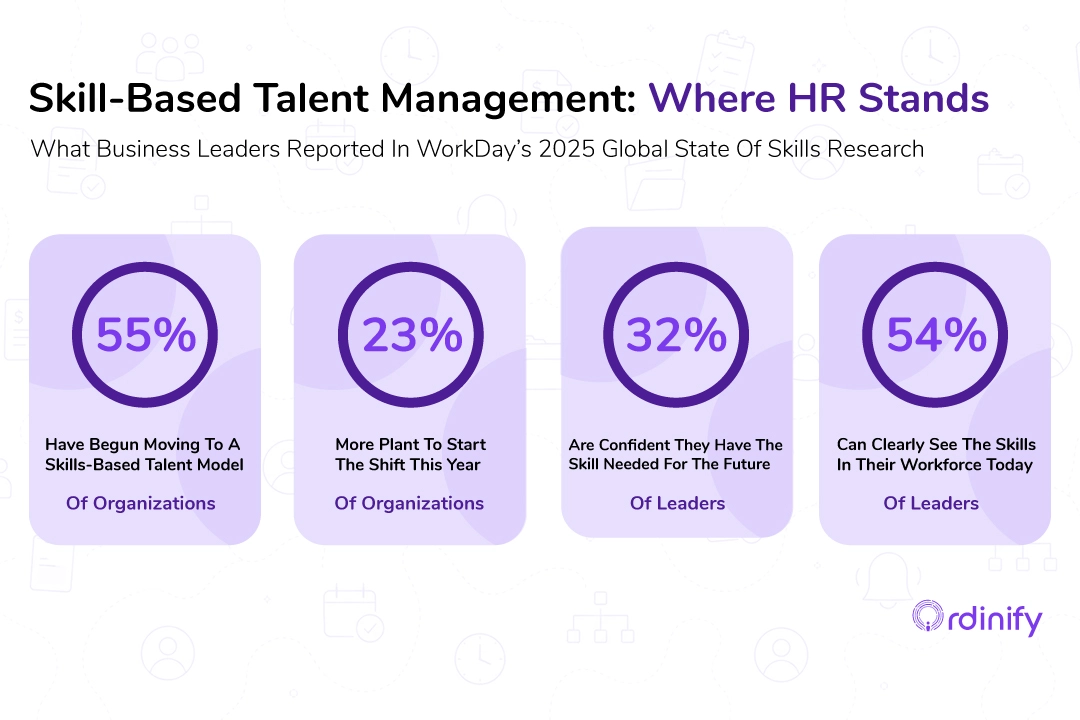
Traditional talent management leaned heavily on credentials and job titles: a specific degree, or a set number of years in a specific role. That's changing. According to Workday's 2025 Global State of Skills research, 55% of organizations have already begun moving to a skills-based talent model, and another 23% planned to start the shift in 2025.
But the same research found a gap between ambition and readiness. Only 32% of business leaders are confident their organization has the skills it needs for long-term success, and just 54% say they can clearly see the skills within their workforce today. That visibility gap is often the real blocker. It isn't a lack of willingness to change, but a lack of centralized data to make skills-based decisions from.
The Most Common Mistake: Building a Framework on Disconnected Tools
Here's where most talent management frameworks quietly fall apart: they're designed on paper as one connected system, then run in practice as five separate ones. Recruitment lives in an applicant tracking tool. Performance reviews happen in a different platform, if they happen in a platform at all. Succession planning ends up in a spreadsheet someone updates once a year. Payroll runs somewhere else entirely, disconnected from all of it.
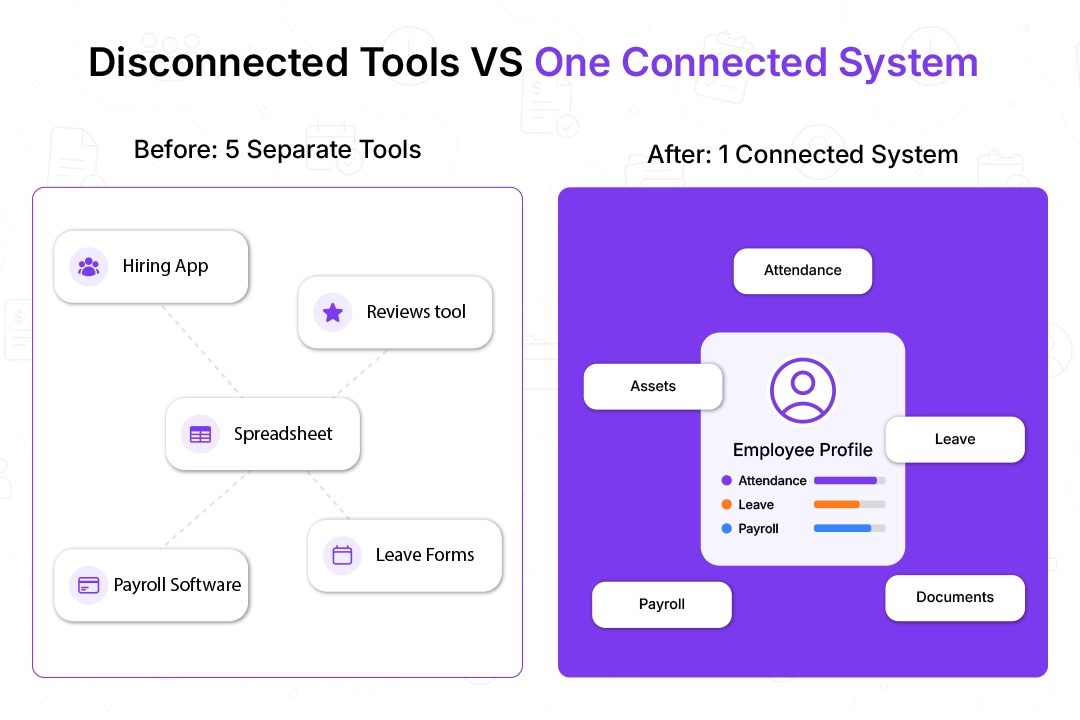
Every one of these handoffs is a place where data goes stale. A promotion doesn't show up in pay for a month. A skills gap stays invisible because nobody is looking at recruitment data and performance data side by side.
A talent management framework works best when the underlying system really is one system, where an employee's attendance, leave requests, documents, equipment, and pay all update the same profile instead of living in five tools that don't talk to each other.
Building Your Talent Management Framework in 2026: Where to Start
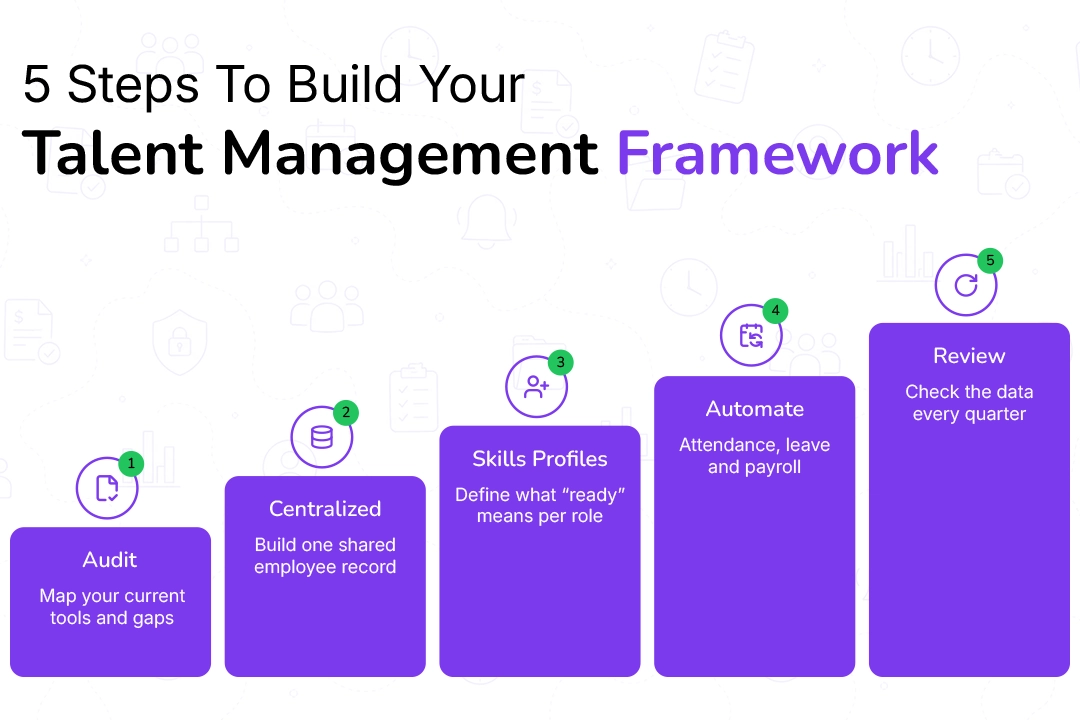
- Audit what you have. Before adding anything, map your current recruitment, onboarding, performance, and payroll processes, and be honest about which ones are disconnected from each other.
- Centralize the employee record. Every framework component works better when it's built on the same source of truth, not a patchwork of separate databases.
- Build role-based skills profiles. Define what "ready for the next level" looks like for key roles, so development and succession planning have something concrete to work from.
- Automate the administrative layer. Time spent manually reconciling attendance, leave, and payroll is time not spent on talent strategy.
- Review the data quarterly, not annually. Retention and skills gaps move faster than a once-a-year review cycle can catch.
What This Looks Like Across Industries
The shape of a talent management framework shifts depending on the industry. A tech company managing distributed engineering teams is solving for remote onboarding and multi-country payroll. A hospital is solving for credential-aware scheduling, where talent management and compliance are effectively the same problem. A retail chain is managing seasonal hiring surges and commission-linked performance across dozens of outlets. The core components stay the same, but the systems supporting them need to flex to the industry.
Bringing It Together
A talent management framework isn't a document HR writes once and files away. It's the connected system your people processes run on. The organizations that get the most out of theirs tend to have one thing in common: their HR data lives in one place, not six.
If you're building or rebuilding your talent management framework for 2026, Ordinify brings recruitment, performance, attendance, leave, payroll, documents, and assets into a single platform, so the framework you design on paper is the one your team runs on. Book a demo to see how it works.